
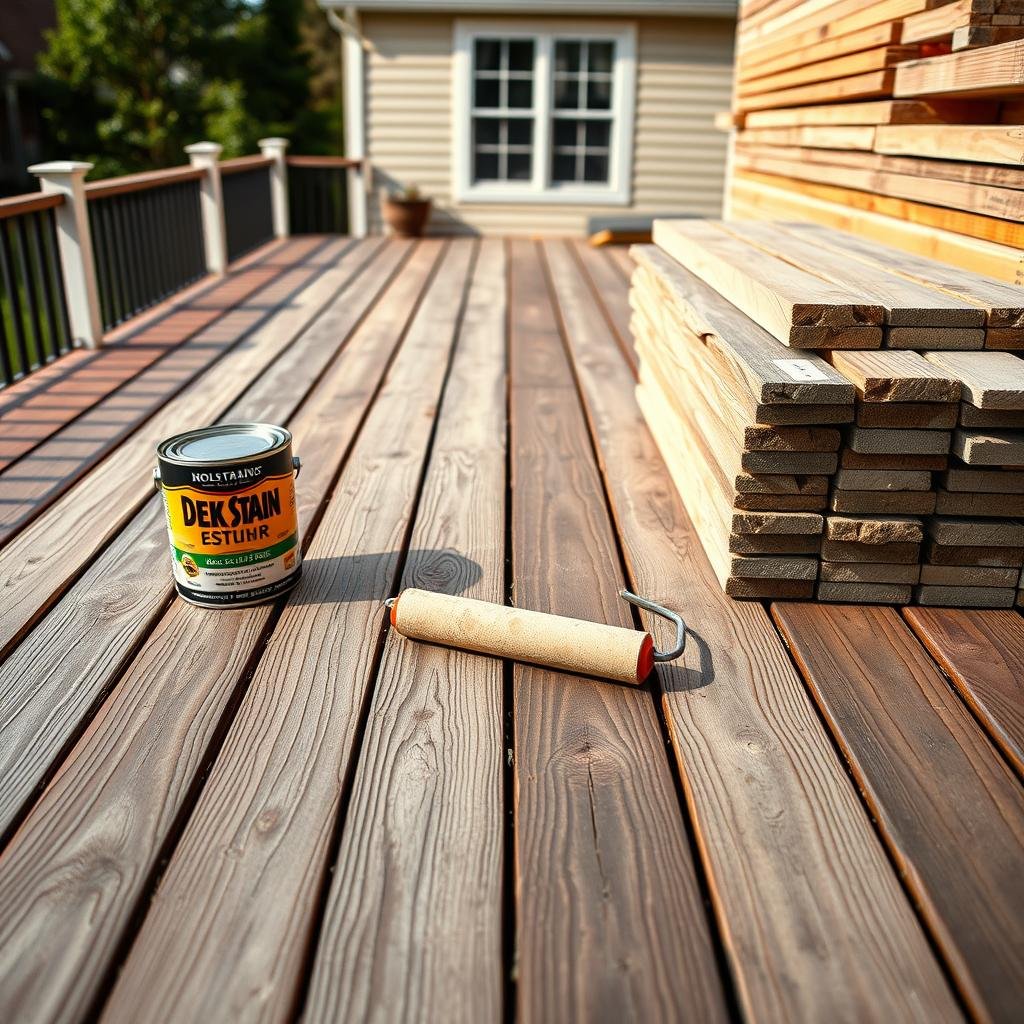
"Should I just restain it or am I past that?" is one of the most common questions we get, especially in spring. The honest answer is one of three: stain only, repair + stain, or replace. The difference is structural - and you can usually figure out which one applies in 10 minutes with an awl and a flashlight.
3 Tests That Decide Your Path
Run these three tests on your deck this weekend. The combined results point to the right path.
Test 1: The Awl Test
Press an awl or sharpened screwdriver into the deck boards over each joist. Sound wood resists; rotted wood sinks 1/4 inch or more under hand pressure. Mark soft spots with painter's tape. Then crawl under the deck and probe the joists themselves and the ledger.
Test 2: The Walk Test
Walk every square foot of the deck barefoot. Mark anywhere the boards feel soft, spongy, or visibly flex underfoot. Check the stairs - any tread that flexes under your weight is a structural issue, not a cosmetic one.
Test 3: The Railing Push
Push hard on every railing post with both hands at chest height. Anything that flexes more than 1/2 inch needs work. While you are there, wiggle each baluster - any that move easily are loose.
Now tally the results. The combined picture tells you what to do next.
When Stain Alone Is the Right Call
You are looking at a stain-only candidate if all three are true:
- Awl test passes everywhere - no soft spots in boards, joists, or ledger
- Walk test passes - no spongy spots, no flexing stairs
- Railing push passes - posts barely move, balusters are tight
At that point you have a structurally sound deck that just needs cosmetic protection. Wash and sand prep, then two coats of penetrating oil-based stain. Cost: $4 per square foot of walking surface plus prep from $900, so typically $1,700 to $3,300 for prep and surface, and more once full-perimeter railings, balusters, and stairs are in the scope. Whole stain projects run $850 to $5,100. Resets the deck for another 2 to 3 years before the next stain cycle.
When Repair + Stain Makes Sense
You are looking at repair-and-stain if some of these apply:
- 1 to 5 board-level soft spots that need replacement
- 1 to 4 sistered joists needed under specific failed boards
- Loose railing posts that can be re-anchored or replaced
- Stair tread or two needs rebuilding
- The rest of the structure passes the awl test
This is by far the most common path for decks in the 12 to 20 year window. Targeted board replacement runs $20 per square foot repaired, with most repairs in the $450 to $2,400 range. Add the stain (prep from $900 plus $4/sqft of walking surface) once the new boards have dried. Combined, most of these land between $1,500 and $9,000 depending on how much joist, ledger, stair, and railing work comes with them - and that buys you another 5 to 8 years of safe use without a full rebuild.
Important sequence
Always repair THEN stain - never the other way around. Staining first locks soft spots in place where you cannot see them, and the new stain ends up doing nothing useful for the boards that are about to fail anyway. We quote repair and stain as one project. Standard pressure-treated boards need 30 to 60 days to dry before stain (when water soaks in instead of beading, they are ready), so the stain goes down on a return visit. Kiln-dried (KDAT) boards can be stained within days if you want one trip.
When to Skip Straight to Replace
Replace if two or more of these apply:
- More than 30% of the joists fail the awl test
- The ledger is rotted or you can see daylight behind it
- Railing posts have rotted bases that cannot be re-anchored
- Multiple sections of decking have failed at once
- Footings have shifted, heaved, or sunk
- You hate the original layout or want to switch to composite for the next round
At the replace point, money spent on repair and stain is money you are going to have to spend twice. Full tear-down and rebuild starts at $15,000 for a small pressure-treated deck and runs to $45,000+ for a large composite or steel-framed project with premium railings.
Cost Comparison
| Path | Per sqft | Typical Project | Adds Years |
|---|---|---|---|
| Stain only | $4 + prep from $900 | $850 - $5,100 | +2 to 3 years |
| Repair + stain | $20 + $4 + prep | $1,500 - $9,000 | +5 to 8 years |
| Tear-down + PT rebuild | $50 | $15,000 - $42,500 | 15 to 25 years (new lifecycle) |
| Tear-down + composite rebuild | $55-$75 | $18,000 - $45,000 | 25 to 30+ years (new lifecycle) |
Our Restain Process
- Photo review. Send us photos and your awl test results for a free review. We tell you whether stain alone is the right call or whether you need repair first.
- Repair (if needed). Replace any failed boards, sister joists where required.
- Pressure wash. Low-pressure clean with deck-safe detergent to lift dirt, mildew, and old stain. Wash and sand prep is its own line, from $900, and takes about two crew days at any deck size.
- Light sand. Smooth any raised grain or rough patches.
- Two coats of penetrating oil-based stain. Brush, roll, or spray depending on the board profile.
- Walkthrough and warranty. 2-year workmanship warranty on any repair work.