
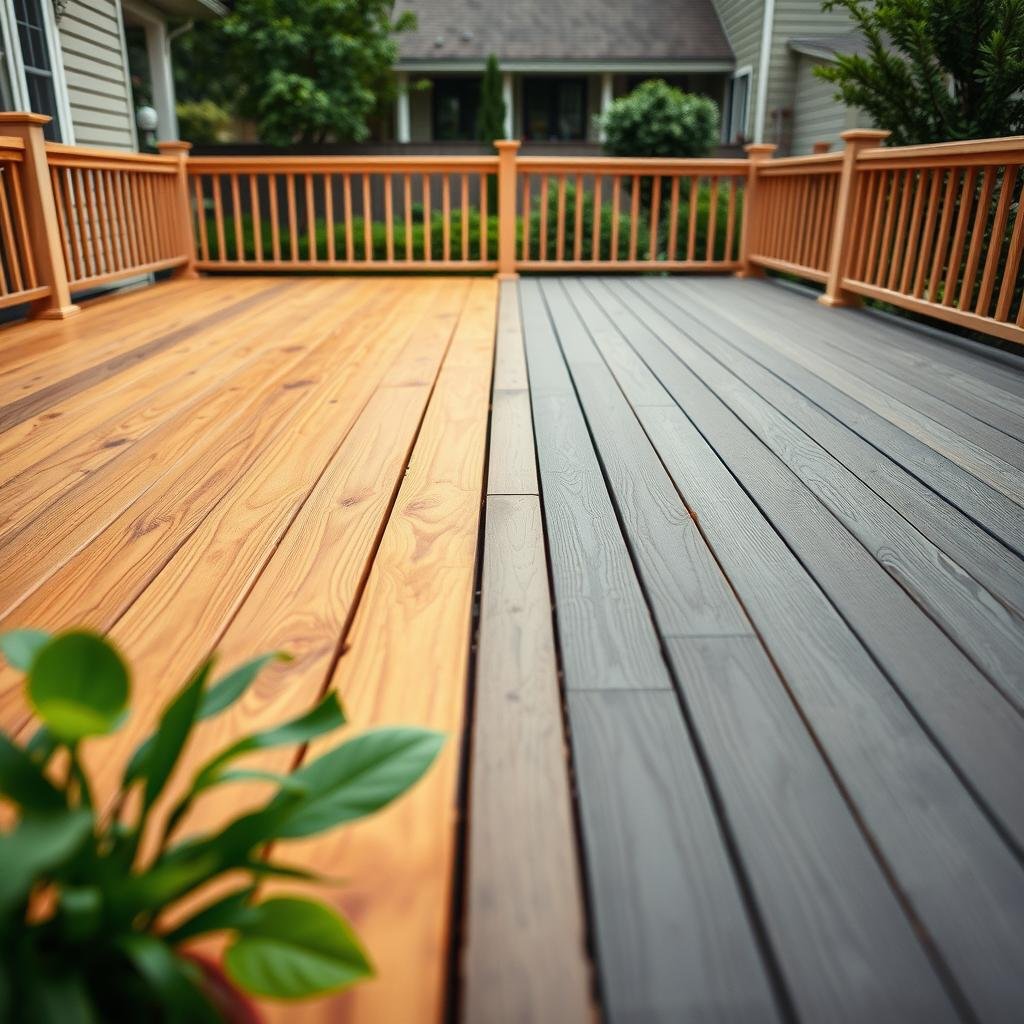
The "should I go wood or composite" question comes up on almost every first call in our service area. There is no universally right answer - it depends on how long you are staying, how much yard work you actually enjoy, and whether your deck sits in full sun or under 50-year oaks. Here is how our team thinks about the tradeoffs, with Charlotte climate front and center.
Upfront Cost Per Square Foot
Our installed per-square-foot rates in the Charlotte metro:
- Pressure-treated pine: $50/sqft installed
- Trex Select (entry composite): $55/sqft installed
- Trex Transcend (premium composite): $75/sqft installed
For a 300 sqft deck, that is $15,000 for pressure-treated, $16,500 for Trex Select, and $22,500 for Trex Transcend. The composite premium is real - 50% to 2x the upfront cost of wood.
How Each Material Handles Charlotte Humidity
Pressure-treated pine
In the 43-inch-rain, 65-80% summer humidity climate of Charlotte and York County, pressure-treated pine typically lasts 15 to 25 years when properly maintained. The treatment chemistry resists rot fungi for the first 10 to 12 years without much help. After that, anywhere water lingers - the gap above a joist, the first board against the house, the bottom stair tread - starts to fail. A deck under heavy oak canopy in Marvin or Weddington fails faster than an open-yard deck in Ballantyne or Indian Land.
Composite (Trex, TimberTech)
Polymer-capped composite boards are essentially humidity-proof - the plastic cap sheds water, and the wood fiber inside is encapsulated. 25-year fade-and-stain warranties are standard and in our field experience they hold up. Where composite fails in our climate is underneath - the pressure-treated framing supporting the composite boards is subject to the same humidity as an all-wood deck, so ledger flashing and proper ventilation still matter.
Surface Heat in July and August
Charlotte summers regularly hit 95F+ with strong sun exposure. Deck surface temps we have measured on client jobs in Weddington and Fort Mill:
| Material | Color | Peak Temp (Aug, full sun) |
|---|---|---|
| Pressure-treated | Natural / grey | 115-125F |
| Pressure-treated | Dark stain | 130-140F |
| Trex Select | Light (Pebble Grey) | 125-135F |
| Trex Transcend | Dark (Spiced Rum) | 145-155F |
If barefoot usage matters, pick a lighter composite color or stay with natural-finish pressure-treated. Dark composite on a south-facing Charlotte deck gets uncomfortable in full summer sun.
Maintenance Over 20 Years
Pressure-treated, 300 sqft deck
- Initial install: $15,000
- Stain every 2.5 years x 8 cycles: 8 x ($2,100 prep + surface) = $16,800
- Board replacement at year 17: ~$3,500 repair on a typical deck, more if the joists or ledger are involved
- 20-year total: ~$35,300
Trex Select, 300 sqft deck
- Initial install: $16,500
- Stain: $0 (not needed)
- Framing inspection + possible joist repair at year 15: ~$800
- 20-year total: ~$17,300
Over 20 years the two options end up within a few thousand dollars of each other. Composite wins on your time and weekend hours more than on total dollars. If staining your own deck every 2 to 3 years does not bother you, pressure-treated is a perfectly reasonable choice.
South-Charlotte tip
Homes in 28173 (Marvin / Waxhaw) and 28104 (Weddington) sit under heavy tree canopy. Wood decks under that canopy dry slowly and rot faster than published averages. If you are in one of those zips, composite shifts from a preference to a financial decision in your favor.
Hybrid Builds That Save Money
Two hybrid patterns save real money without giving up the composite advantages homeowners actually notice.
Composite boards + wood railings
You feel the boards under your feet every day, rarely touch the railing. Composite boards ($55/sqft) with pressure-treated wood railings shaves 10-15% off the full-composite price and keeps the no-stain deck surface.
Pressure-treated + glass railings
The opposite move: keep pressure-treated boards (accept the maintenance), spend the saved budget on frameless glass railings at $425-$900/LF. Works well on lake-view decks in Lake Wylie or Tega Cay where the view is the premium, not the board surface.
Which Should You Pick?
- Staying 5 years or less: pressure-treated. The composite premium does not pay back in 5 years.
- Staying 10+ years and you hate yard maintenance: Trex Select or equivalent. Time savings alone justifies it.
- Entertaining on the deck, indoor-outdoor aesthetic: Trex Transcend. The tropical-hardwood look is real. See our premium composite decks page for details.
- Tight budget, willing to stain every 2 to 3 years: pressure-treated with a proper flashing job.